


%20--%3e%3csvg%20xmlns:dc='http://purl.org/dc/elements/1.1/'%20xmlns:cc='http://creativecommons.org/ns%23'%20xmlns:rdf='http://www.w3.org/1999/02/22-rdf-syntax-ns%23'%20xmlns:svg='http://www.w3.org/2000/svg'%20xmlns='http://www.w3.org/2000/svg'%20xmlns:sodipodi='http://sodipodi.sourceforge.net/DTD/sodipodi-0.dtd'%20xmlns:inkscape='http://www.inkscape.org/namespaces/inkscape'%20version='1.1'%20id='svg815'%20xml:space='preserve'%20width='218.668'%20height='356.444'%20viewBox='0%200%20218.668%20356.444'%20sodipodi:docname='wa-loader.svg'%20inkscape:version='0.92.3%20(2405546,%202018-03-11)'%3e%3cmetadata%20id='metadata821'%3e%3crdf:RDF%3e%3ccc:Work%20rdf:about=''%3e%3cdc:format%3eimage/svg+xml%3c/dc:format%3e%3cdc:type%20rdf:resource='http://purl.org/dc/dcmitype/StillImage'%20/%3e%3cdc:title%3e%3c/dc:title%3e%3c/cc:Work%3e%3c/rdf:RDF%3e%3c/metadata%3e%3cdefs%20id='defs819'%3e%3cclipPath%20clipPathUnits='userSpaceOnUse'%20id='clipPath831'%3e%3cpath%20d='M%200,2016%20H%201584%20V%200%20H%200%20Z'%20id='path829'%20inkscape:connector-curvature='0'%20/%3e%3c/clipPath%3e%3c/defs%3e%3csodipodi:namedview%20pagecolor='%23ffffff'%20bordercolor='%23666666'%20borderopacity='1'%20objecttolerance='10'%20gridtolerance='10'%20guidetolerance='10'%20inkscape:pageopacity='0'%20inkscape:pageshadow='2'%20inkscape:window-width='1598'%20inkscape:window-height='1027'%20id='namedview817'%20showgrid='false'%20fit-margin-top='0'%20fit-margin-left='0'%20fit-margin-right='0'%20fit-margin-bottom='0'%20inkscape:zoom='0.31994048'%20inkscape:cx='85.140208'%20inkscape:cy='159.7767'%20inkscape:window-x='1754'%20inkscape:window-y='-8'%20inkscape:window-maximized='1'%20inkscape:current-layer='g823'%20/%3e%3cg%20id='g823'%20inkscape:groupmode='layer'%20inkscape:label='wineglass'%20transform='matrix(1.3333333,0,0,-1.3333333,-984.92491,1540.6673)'%3e%3cg%20id='g825'%3e%3cg%20id='g827'%20clip-path='url(%23clipPath831)'%3e%3cg%20id='g833'%20transform='translate(900.1943,1067.3335)'%3e%3cpath%20d='m%200,0%20c%200,51.333%20-34.334,85.667%20-34.334,85.667%20h%20-43.332%20-3.667%20-43.335%20c%200,0%20-34.333,-34.334%20-34.333,-85.667%200,-49.497%2044.315,-76.675%2077.668,-78.558%20v%20-0.025%20c%200.605,0%201.219,-0.072%201.834,-0.054%200.613,-0.018%201.226,0.054%201.833,0.054%20v%200.025%20C%20-44.314,-76.675%200,-49.497%200,0'%20style='fill:%23ffffff;fill-opacity:1;fill-rule:nonzero;stroke:none'%20id='path835'%20inkscape:connector-curvature='0'%20/%3e%3c/g%3e%3cg%20id='g837'%20transform='translate(822.3877,991.2715)'%3e%3cpath%20d='m%200,0%20c%20-0.089,-0.005%20-0.176,-0.015%20-0.261,-0.028%20-0.179,-0.007%20-0.36,-0.016%20-0.54,-0.025%20-0.229,-0.011%20-0.46,-0.025%20-0.689,-0.025%20l%20-0.131,0.002%20c%20-0.024,0.001%20-0.048,0.001%20-0.071,0.001%20-0.024,0%20-0.048,0%20-0.072,-0.001%20l%20-0.131,-0.002%20c%20-0.231,0%20-0.462,0.014%20-0.692,0.025%20-0.179,0.009%20-0.357,0.018%20-0.535,0.024%20-0.086,0.014%20-0.174,0.024%20-0.264,0.029%20-30.37,1.715%20-75.308,27.074%20-75.308,76.062%200,45.622%2028.095,77.965%2032.907,83.167%20H%2042.398%20C%2047.21,154.027%2075.307,121.684%2075.307,76.062%2075.307,27.074%2030.37,1.715%200,0%20m%2045.24,163.496%20c%20-0.469,0.469%20-1.104,0.733%20-1.767,0.733%20h%20-90.334%20c%20-0.663,0%20-1.299,-0.264%20-1.768,-0.733%20-1.432,-1.432%20-35.065,-35.66%20-35.065,-87.434%200,-29.304%2014.785,-48.271%2027.189,-59.023%2014.578,-12.637%2034.094,-20.833%2052.311,-21.996%20v%20-93.147%20h%20-49.875%20v%20-5%20H%2050.682%20v%205%20H%200.806%20v%2093.148%20c%2018.217,1.162%2037.734,9.358%2052.312,21.995%2012.403,10.752%2027.189,29.719%2027.189,59.023%200,51.774%20-33.635,86.002%20-35.067,87.434'%20style='fill:%23231f20;fill-opacity:1;fill-rule:nonzero;stroke:none'%20id='path839'%20inkscape:connector-curvature='0'%20/%3e%3c/g%3e%3c/g%3e%3c/g%3e%3c/g%3e%3c/svg%3e)
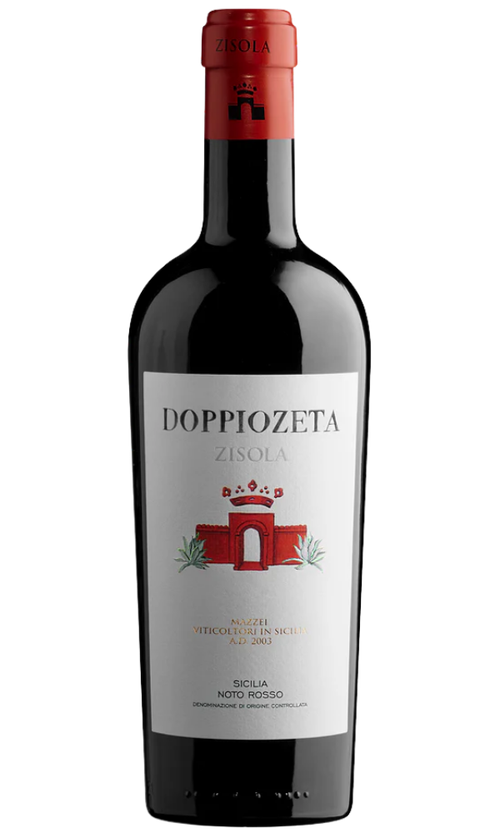
A benchmark Nero d’Avola from a legendary Tuscan dynasty—with elegance, reserved power, and poise
- Curated by unrivaled experts
- Choose your delivery date
- Temperature controlled shipping options
- Get credited back if a wine fails to impress
2018 Marchesi Mazzei Doppiozeta Zisola Sicilia Noto Rosso 750 ml
| $35 | per bottle | |
- Curated by unrivaled experts
- Choose your delivery date
- Temperature controlled shipping options
- Get credited back if a wine fails to impress
Six Centuries in the Making
The Mazzei family has been making wine in Tuscany since 1435. That’s not a marketing claim—it’s a verifiable fact, one that places the family among the oldest wine dynasties in Italy and puts their arrival in Sicily in 2003 in proper context. When a family with six centuries of accumulated knowledge identifies a new terroir as worthy of their attention, it’s worth paying attention.
After five years of searching, Francesco and Filippo Mazzei settled on 50 acres of land just outside Noto in southeastern Sicily—a UNESCO World Heritage Site famous for its baroque architecture and, less famously but no less importantly, for the calcareous, sandy soils that produce some of the island’s finest Nero d’Avola. The estate took the name Zisola. The flagship wine took the name Doppiozeta—“double Z”—a quiet signature encoding both the family name and the estate’s: one Z for Mazzei, one for Zisola.
The terroir at Zisola rewards patience and restraint. Elevations between 310 and 425 feet, calcareous soils that are nutrient-poor by design, and Mediterranean breezes that moderate the summer heat all conspire to rein in Nero d’Avola’s natural exuberance and coax something more precise and mineral from the grape than the island has historically been known for.
Doppiozeta is sourced from three distinct parcels—Piscina, Sopra Navel, and Mandorleto—each farmed using the traditional Sicilian albarello system, which requires 400 hours of hand labor per hectare per year. The parcels are harvested and vinified separately, with natural fermentation in small stainless steel tanks over 30 days, no added yeasts, and spontaneous malolactic fermentation in oak. Aging lasts 16 months in 500-liter French oak barrels, half of them new.
The 2018 vintage was a fortunate one—a cold, wet winter gave the vines a healthy start, a warm dry summer created ideal conditions for the fruit, and harvest ran from late August through late September. The estate described it as particularly promising, and the wine bears that out.
You might also like these wines
- Member Favorite




- You're on page