


%20--%3e%3csvg%20xmlns:dc='http://purl.org/dc/elements/1.1/'%20xmlns:cc='http://creativecommons.org/ns%23'%20xmlns:rdf='http://www.w3.org/1999/02/22-rdf-syntax-ns%23'%20xmlns:svg='http://www.w3.org/2000/svg'%20xmlns='http://www.w3.org/2000/svg'%20xmlns:sodipodi='http://sodipodi.sourceforge.net/DTD/sodipodi-0.dtd'%20xmlns:inkscape='http://www.inkscape.org/namespaces/inkscape'%20version='1.1'%20id='svg815'%20xml:space='preserve'%20width='218.668'%20height='356.444'%20viewBox='0%200%20218.668%20356.444'%20sodipodi:docname='wa-loader.svg'%20inkscape:version='0.92.3%20(2405546,%202018-03-11)'%3e%3cmetadata%20id='metadata821'%3e%3crdf:RDF%3e%3ccc:Work%20rdf:about=''%3e%3cdc:format%3eimage/svg+xml%3c/dc:format%3e%3cdc:type%20rdf:resource='http://purl.org/dc/dcmitype/StillImage'%20/%3e%3cdc:title%3e%3c/dc:title%3e%3c/cc:Work%3e%3c/rdf:RDF%3e%3c/metadata%3e%3cdefs%20id='defs819'%3e%3cclipPath%20clipPathUnits='userSpaceOnUse'%20id='clipPath831'%3e%3cpath%20d='M%200,2016%20H%201584%20V%200%20H%200%20Z'%20id='path829'%20inkscape:connector-curvature='0'%20/%3e%3c/clipPath%3e%3c/defs%3e%3csodipodi:namedview%20pagecolor='%23ffffff'%20bordercolor='%23666666'%20borderopacity='1'%20objecttolerance='10'%20gridtolerance='10'%20guidetolerance='10'%20inkscape:pageopacity='0'%20inkscape:pageshadow='2'%20inkscape:window-width='1598'%20inkscape:window-height='1027'%20id='namedview817'%20showgrid='false'%20fit-margin-top='0'%20fit-margin-left='0'%20fit-margin-right='0'%20fit-margin-bottom='0'%20inkscape:zoom='0.31994048'%20inkscape:cx='85.140208'%20inkscape:cy='159.7767'%20inkscape:window-x='1754'%20inkscape:window-y='-8'%20inkscape:window-maximized='1'%20inkscape:current-layer='g823'%20/%3e%3cg%20id='g823'%20inkscape:groupmode='layer'%20inkscape:label='wineglass'%20transform='matrix(1.3333333,0,0,-1.3333333,-984.92491,1540.6673)'%3e%3cg%20id='g825'%3e%3cg%20id='g827'%20clip-path='url(%23clipPath831)'%3e%3cg%20id='g833'%20transform='translate(900.1943,1067.3335)'%3e%3cpath%20d='m%200,0%20c%200,51.333%20-34.334,85.667%20-34.334,85.667%20h%20-43.332%20-3.667%20-43.335%20c%200,0%20-34.333,-34.334%20-34.333,-85.667%200,-49.497%2044.315,-76.675%2077.668,-78.558%20v%20-0.025%20c%200.605,0%201.219,-0.072%201.834,-0.054%200.613,-0.018%201.226,0.054%201.833,0.054%20v%200.025%20C%20-44.314,-76.675%200,-49.497%200,0'%20style='fill:%23ffffff;fill-opacity:1;fill-rule:nonzero;stroke:none'%20id='path835'%20inkscape:connector-curvature='0'%20/%3e%3c/g%3e%3cg%20id='g837'%20transform='translate(822.3877,991.2715)'%3e%3cpath%20d='m%200,0%20c%20-0.089,-0.005%20-0.176,-0.015%20-0.261,-0.028%20-0.179,-0.007%20-0.36,-0.016%20-0.54,-0.025%20-0.229,-0.011%20-0.46,-0.025%20-0.689,-0.025%20l%20-0.131,0.002%20c%20-0.024,0.001%20-0.048,0.001%20-0.071,0.001%20-0.024,0%20-0.048,0%20-0.072,-0.001%20l%20-0.131,-0.002%20c%20-0.231,0%20-0.462,0.014%20-0.692,0.025%20-0.179,0.009%20-0.357,0.018%20-0.535,0.024%20-0.086,0.014%20-0.174,0.024%20-0.264,0.029%20-30.37,1.715%20-75.308,27.074%20-75.308,76.062%200,45.622%2028.095,77.965%2032.907,83.167%20H%2042.398%20C%2047.21,154.027%2075.307,121.684%2075.307,76.062%2075.307,27.074%2030.37,1.715%200,0%20m%2045.24,163.496%20c%20-0.469,0.469%20-1.104,0.733%20-1.767,0.733%20h%20-90.334%20c%20-0.663,0%20-1.299,-0.264%20-1.768,-0.733%20-1.432,-1.432%20-35.065,-35.66%20-35.065,-87.434%200,-29.304%2014.785,-48.271%2027.189,-59.023%2014.578,-12.637%2034.094,-20.833%2052.311,-21.996%20v%20-93.147%20h%20-49.875%20v%20-5%20H%2050.682%20v%205%20H%200.806%20v%2093.148%20c%2018.217,1.162%2037.734,9.358%2052.312,21.995%2012.403,10.752%2027.189,29.719%2027.189,59.023%200,51.774%20-33.635,86.002%20-35.067,87.434'%20style='fill:%23231f20;fill-opacity:1;fill-rule:nonzero;stroke:none'%20id='path839'%20inkscape:connector-curvature='0'%20/%3e%3c/g%3e%3c/g%3e%3c/g%3e%3c/g%3e%3c/svg%3e)
Decanter: “Impressive, well-balanced wine with real drive.”
- 95 pts Decanter95 pts Decanter
- Curated by unrivaled experts
- Choose your delivery date
- Temperature controlled shipping options
- Get credited back if a wine fails to impress
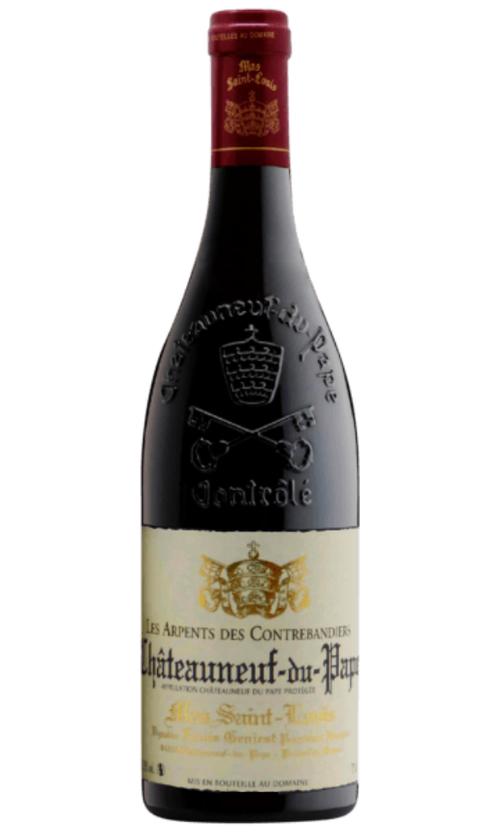
2018 Mas Saint Louis Les Arpents de Contrebandiers Chateauneuf-du-Pape 750 ml
- Curated by unrivaled experts
- Choose your delivery date
- Temperature controlled shipping options
- Get credited back if a wine fails to impress
The Little-Known “Smugglers’ Acres”
The renaissance of great wine in Europe after WWII is the story of small domaine-bottlers: people who formerly sold their fruit to a co-operative, a négociant, or a large winery. Suddenly, an ambitious kid decides to strike out on their own. Suddenly, the family’s ancient vineyard is revealed to the world as something truly special.
This is the story of Mas Saint-Louis, but with a twist: The ambitious owner here is no kid.
This is a small winery that was founded in 1890, but has only been domaine-bottling since 2011. That’s thanks to 90-year old Monique Geniest, who is assisted in working these 30 hectares by cellarmaster Matthieu Faurie-Grépon.
Mme. Geniest made the courageous decision to stop selling to négociants so late in life, but it paid off: In 2015, French critics Bettane & Desseauve named Domaine Mas Saint-Louis their “discovery of the year,” describing it as “a future cult property for the region.”
“Les Arpents des Contrebandiers” means “Smugglers’ Acres,” a reference to this bend in the Rhône’s sordid history as a haven for outlaws. This wine was made from 75% Grenache, 10% Mourvedre, 10% Syrah and 5% Cinsault, all grown on a single vineyard, “La Crousroute,” in the southernmost lieu-dit in the Châteauneuf-du-Pape appellation. It’s filled with well-draining gravel and blanketed with the characteristic “pudding stone” river rocks that absorb heat during the day and radiate it back to the bunches at night.
No new wood is employed here—the wines are vinified in old concrete tanks and neutral wood demi-muids for about a year before bottling. This gives a beautiful freshness on the palate, and aromas of fresh strawberries, fresh earth, leather, rosemary, red cherries, and vanilla.
You might also like these wines



- You're on page