


%20--%3e%3csvg%20xmlns:dc='http://purl.org/dc/elements/1.1/'%20xmlns:cc='http://creativecommons.org/ns%23'%20xmlns:rdf='http://www.w3.org/1999/02/22-rdf-syntax-ns%23'%20xmlns:svg='http://www.w3.org/2000/svg'%20xmlns='http://www.w3.org/2000/svg'%20xmlns:sodipodi='http://sodipodi.sourceforge.net/DTD/sodipodi-0.dtd'%20xmlns:inkscape='http://www.inkscape.org/namespaces/inkscape'%20version='1.1'%20id='svg815'%20xml:space='preserve'%20width='218.668'%20height='356.444'%20viewBox='0%200%20218.668%20356.444'%20sodipodi:docname='wa-loader.svg'%20inkscape:version='0.92.3%20(2405546,%202018-03-11)'%3e%3cmetadata%20id='metadata821'%3e%3crdf:RDF%3e%3ccc:Work%20rdf:about=''%3e%3cdc:format%3eimage/svg+xml%3c/dc:format%3e%3cdc:type%20rdf:resource='http://purl.org/dc/dcmitype/StillImage'%20/%3e%3cdc:title%3e%3c/dc:title%3e%3c/cc:Work%3e%3c/rdf:RDF%3e%3c/metadata%3e%3cdefs%20id='defs819'%3e%3cclipPath%20clipPathUnits='userSpaceOnUse'%20id='clipPath831'%3e%3cpath%20d='M%200,2016%20H%201584%20V%200%20H%200%20Z'%20id='path829'%20inkscape:connector-curvature='0'%20/%3e%3c/clipPath%3e%3c/defs%3e%3csodipodi:namedview%20pagecolor='%23ffffff'%20bordercolor='%23666666'%20borderopacity='1'%20objecttolerance='10'%20gridtolerance='10'%20guidetolerance='10'%20inkscape:pageopacity='0'%20inkscape:pageshadow='2'%20inkscape:window-width='1598'%20inkscape:window-height='1027'%20id='namedview817'%20showgrid='false'%20fit-margin-top='0'%20fit-margin-left='0'%20fit-margin-right='0'%20fit-margin-bottom='0'%20inkscape:zoom='0.31994048'%20inkscape:cx='85.140208'%20inkscape:cy='159.7767'%20inkscape:window-x='1754'%20inkscape:window-y='-8'%20inkscape:window-maximized='1'%20inkscape:current-layer='g823'%20/%3e%3cg%20id='g823'%20inkscape:groupmode='layer'%20inkscape:label='wineglass'%20transform='matrix(1.3333333,0,0,-1.3333333,-984.92491,1540.6673)'%3e%3cg%20id='g825'%3e%3cg%20id='g827'%20clip-path='url(%23clipPath831)'%3e%3cg%20id='g833'%20transform='translate(900.1943,1067.3335)'%3e%3cpath%20d='m%200,0%20c%200,51.333%20-34.334,85.667%20-34.334,85.667%20h%20-43.332%20-3.667%20-43.335%20c%200,0%20-34.333,-34.334%20-34.333,-85.667%200,-49.497%2044.315,-76.675%2077.668,-78.558%20v%20-0.025%20c%200.605,0%201.219,-0.072%201.834,-0.054%200.613,-0.018%201.226,0.054%201.833,0.054%20v%200.025%20C%20-44.314,-76.675%200,-49.497%200,0'%20style='fill:%23ffffff;fill-opacity:1;fill-rule:nonzero;stroke:none'%20id='path835'%20inkscape:connector-curvature='0'%20/%3e%3c/g%3e%3cg%20id='g837'%20transform='translate(822.3877,991.2715)'%3e%3cpath%20d='m%200,0%20c%20-0.089,-0.005%20-0.176,-0.015%20-0.261,-0.028%20-0.179,-0.007%20-0.36,-0.016%20-0.54,-0.025%20-0.229,-0.011%20-0.46,-0.025%20-0.689,-0.025%20l%20-0.131,0.002%20c%20-0.024,0.001%20-0.048,0.001%20-0.071,0.001%20-0.024,0%20-0.048,0%20-0.072,-0.001%20l%20-0.131,-0.002%20c%20-0.231,0%20-0.462,0.014%20-0.692,0.025%20-0.179,0.009%20-0.357,0.018%20-0.535,0.024%20-0.086,0.014%20-0.174,0.024%20-0.264,0.029%20-30.37,1.715%20-75.308,27.074%20-75.308,76.062%200,45.622%2028.095,77.965%2032.907,83.167%20H%2042.398%20C%2047.21,154.027%2075.307,121.684%2075.307,76.062%2075.307,27.074%2030.37,1.715%200,0%20m%2045.24,163.496%20c%20-0.469,0.469%20-1.104,0.733%20-1.767,0.733%20h%20-90.334%20c%20-0.663,0%20-1.299,-0.264%20-1.768,-0.733%20-1.432,-1.432%20-35.065,-35.66%20-35.065,-87.434%200,-29.304%2014.785,-48.271%2027.189,-59.023%2014.578,-12.637%2034.094,-20.833%2052.311,-21.996%20v%20-93.147%20h%20-49.875%20v%20-5%20H%2050.682%20v%205%20H%200.806%20v%2093.148%20c%2018.217,1.162%2037.734,9.358%2052.312,21.995%2012.403,10.752%2027.189,29.719%2027.189,59.023%200,51.774%20-33.635,86.002%20-35.067,87.434'%20style='fill:%23231f20;fill-opacity:1;fill-rule:nonzero;stroke:none'%20id='path839'%20inkscape:connector-curvature='0'%20/%3e%3c/g%3e%3c/g%3e%3c/g%3e%3c/g%3e%3c/svg%3e)
A rare Petit Verdot-forward Haut-Médoc, organically farmed and family-run
- Curated by unrivaled experts
- Choose your delivery date
- Temperature controlled shipping options
- Get credited back if a wine fails to impress
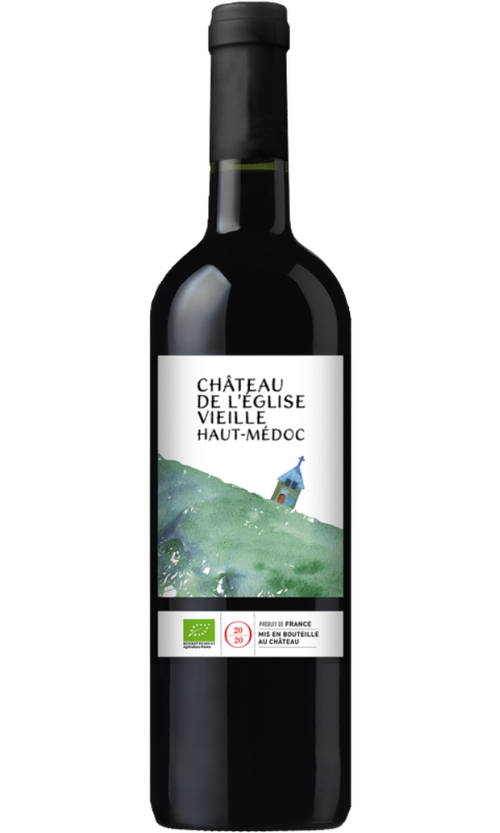
2021 Chateau de l'Eglise Vieille Haut Medoc 750 ml
| $25 | per bottle | |
- Curated by unrivaled experts
- Choose your delivery date
- Temperature controlled shipping options
- Get credited back if a wine fails to impress
A Name Born from Memory
When Damien and Dominique Fedieu's father purchased a plot of land in the Haut-Médoc in 1970, the village elders told him something he wasn't expecting: a church had once stood on this very ground. That piece of local memory became the foundation of an estate. The family named it Château de l'Église Vieille—the old church—and they've been farming it ever since.
More than five decades later, the domaine remains exactly what it was at the start: a family operation, run by people who know every row of the vineyard and every step of the cellar. That kind of continuity is harder to find than it sounds, even in Bordeaux, where family ownership can sometimes mean a boardroom rather than a farmhouse.
What makes the wine itself worth paying attention to is the blend. While most Haut-Médoc bottlings are anchored by Cabernet Sauvignon, Château de l'Église Vieille is built around a near-equal marriage of Merlot and Petit Verdot—48% and 46%, respectively, with just a sliver of Cab to round things out. Petit Verdot at that proportion is rare anywhere in Bordeaux. It brings depth of color, a violet-inflected aromatic lift, and a spice and structure that longer-macerated varieties can't quite replicate. It's an unconventional choice that turns out to be a quietly inspired one.
The estate farms organically, another commitment that speaks to the seriousness of the people behind it. Working without synthetic inputs in Bordeaux—a region that can be unkind to growers who take that path—requires a level of attention and patience that shortcuts can't replace.
The 2021 vintage across the Haut-Médoc was a year that asked a lot of its producers. Spring frosts struck in early April, mildew pressure followed, and the growing season never fully relaxed. What emerged, for those who farmed carefully and picked at the right moment, was a style of Bordeaux that has become genuinely hard to find: fresh, medium-bodied, lower in alcohol, with red fruits and fine tannins that make for drinking pleasure now rather than a decade from now.
You might also like these wines
- Member Favorite
- Member Favorite


- You're on page