


%20--%3e%3csvg%20xmlns:dc='http://purl.org/dc/elements/1.1/'%20xmlns:cc='http://creativecommons.org/ns%23'%20xmlns:rdf='http://www.w3.org/1999/02/22-rdf-syntax-ns%23'%20xmlns:svg='http://www.w3.org/2000/svg'%20xmlns='http://www.w3.org/2000/svg'%20xmlns:sodipodi='http://sodipodi.sourceforge.net/DTD/sodipodi-0.dtd'%20xmlns:inkscape='http://www.inkscape.org/namespaces/inkscape'%20version='1.1'%20id='svg815'%20xml:space='preserve'%20width='218.668'%20height='356.444'%20viewBox='0%200%20218.668%20356.444'%20sodipodi:docname='wa-loader.svg'%20inkscape:version='0.92.3%20(2405546,%202018-03-11)'%3e%3cmetadata%20id='metadata821'%3e%3crdf:RDF%3e%3ccc:Work%20rdf:about=''%3e%3cdc:format%3eimage/svg+xml%3c/dc:format%3e%3cdc:type%20rdf:resource='http://purl.org/dc/dcmitype/StillImage'%20/%3e%3cdc:title%3e%3c/dc:title%3e%3c/cc:Work%3e%3c/rdf:RDF%3e%3c/metadata%3e%3cdefs%20id='defs819'%3e%3cclipPath%20clipPathUnits='userSpaceOnUse'%20id='clipPath831'%3e%3cpath%20d='M%200,2016%20H%201584%20V%200%20H%200%20Z'%20id='path829'%20inkscape:connector-curvature='0'%20/%3e%3c/clipPath%3e%3c/defs%3e%3csodipodi:namedview%20pagecolor='%23ffffff'%20bordercolor='%23666666'%20borderopacity='1'%20objecttolerance='10'%20gridtolerance='10'%20guidetolerance='10'%20inkscape:pageopacity='0'%20inkscape:pageshadow='2'%20inkscape:window-width='1598'%20inkscape:window-height='1027'%20id='namedview817'%20showgrid='false'%20fit-margin-top='0'%20fit-margin-left='0'%20fit-margin-right='0'%20fit-margin-bottom='0'%20inkscape:zoom='0.31994048'%20inkscape:cx='85.140208'%20inkscape:cy='159.7767'%20inkscape:window-x='1754'%20inkscape:window-y='-8'%20inkscape:window-maximized='1'%20inkscape:current-layer='g823'%20/%3e%3cg%20id='g823'%20inkscape:groupmode='layer'%20inkscape:label='wineglass'%20transform='matrix(1.3333333,0,0,-1.3333333,-984.92491,1540.6673)'%3e%3cg%20id='g825'%3e%3cg%20id='g827'%20clip-path='url(%23clipPath831)'%3e%3cg%20id='g833'%20transform='translate(900.1943,1067.3335)'%3e%3cpath%20d='m%200,0%20c%200,51.333%20-34.334,85.667%20-34.334,85.667%20h%20-43.332%20-3.667%20-43.335%20c%200,0%20-34.333,-34.334%20-34.333,-85.667%200,-49.497%2044.315,-76.675%2077.668,-78.558%20v%20-0.025%20c%200.605,0%201.219,-0.072%201.834,-0.054%200.613,-0.018%201.226,0.054%201.833,0.054%20v%200.025%20C%20-44.314,-76.675%200,-49.497%200,0'%20style='fill:%23ffffff;fill-opacity:1;fill-rule:nonzero;stroke:none'%20id='path835'%20inkscape:connector-curvature='0'%20/%3e%3c/g%3e%3cg%20id='g837'%20transform='translate(822.3877,991.2715)'%3e%3cpath%20d='m%200,0%20c%20-0.089,-0.005%20-0.176,-0.015%20-0.261,-0.028%20-0.179,-0.007%20-0.36,-0.016%20-0.54,-0.025%20-0.229,-0.011%20-0.46,-0.025%20-0.689,-0.025%20l%20-0.131,0.002%20c%20-0.024,0.001%20-0.048,0.001%20-0.071,0.001%20-0.024,0%20-0.048,0%20-0.072,-0.001%20l%20-0.131,-0.002%20c%20-0.231,0%20-0.462,0.014%20-0.692,0.025%20-0.179,0.009%20-0.357,0.018%20-0.535,0.024%20-0.086,0.014%20-0.174,0.024%20-0.264,0.029%20-30.37,1.715%20-75.308,27.074%20-75.308,76.062%200,45.622%2028.095,77.965%2032.907,83.167%20H%2042.398%20C%2047.21,154.027%2075.307,121.684%2075.307,76.062%2075.307,27.074%2030.37,1.715%200,0%20m%2045.24,163.496%20c%20-0.469,0.469%20-1.104,0.733%20-1.767,0.733%20h%20-90.334%20c%20-0.663,0%20-1.299,-0.264%20-1.768,-0.733%20-1.432,-1.432%20-35.065,-35.66%20-35.065,-87.434%200,-29.304%2014.785,-48.271%2027.189,-59.023%2014.578,-12.637%2034.094,-20.833%2052.311,-21.996%20v%20-93.147%20h%20-49.875%20v%20-5%20H%2050.682%20v%205%20H%200.806%20v%2093.148%20c%2018.217,1.162%2037.734,9.358%2052.312,21.995%2012.403,10.752%2027.189,29.719%2027.189,59.023%200,51.774%20-33.635,86.002%20-35.067,87.434'%20style='fill:%23231f20;fill-opacity:1;fill-rule:nonzero;stroke:none'%20id='path839'%20inkscape:connector-curvature='0'%20/%3e%3c/g%3e%3c/g%3e%3c/g%3e%3c/g%3e%3c/svg%3e)
A generations-old Campanian estate’s Falanghina, direct from our Italy trip.
- Curated by unrivaled experts
- Choose your delivery date
- Temperature controlled shipping options
- Get credited back if a wine fails to impress
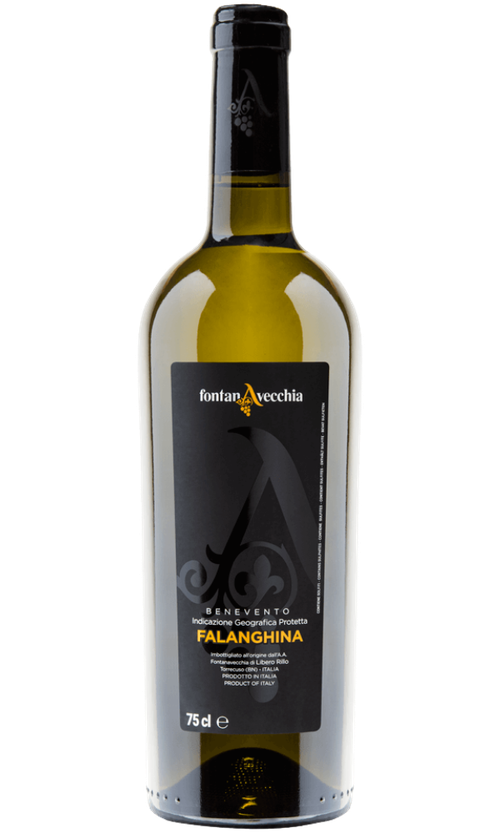
2024 Fontanavecchia Falanghina Benevento 750 ml
- Curated by unrivaled experts
- Choose your delivery date
- Temperature controlled shipping options
- Get credited back if a wine fails to impress
Ancient Grape, Modern Find
We were in Benevento, working our way through the cellars of one of Campania’s most storied estates, when this Falanghina stopped us cold. We tasted it once and bought the lot.
Fontanavecchia has been making wine at the foot of Mount Taburno since the Rillo family established the estate in the 19th century. An old register from the Bourbon era records their wines as the work of attentive caretakers of the vines—guardians of the ancient traditions of the magical city of Benevento. Libero Rillo runs the estate today, supported by his father Orazio and brother Giuseppe, and Fontanavecchia’s Falanghina and Aglianico have become reference points for the entire region.
The vineyards sit at around 300 meters on argillaceous soils laced with lime-rich marlstone, with volcanic deposits from ancient Vesuvian eruptions woven into the mix. Grapes are harvested by hand in the last weeks of September, gently pressed, and fermented cool in stainless steel—a clean, minimal approach designed to keep Falanghina’s natural energy and fragrance intact.
Falanghina is one of the oldest cultivated grapes in southern Italy, its name likely derived from falanga—the Latin word for the wooden stakes used to train vines in antiquity, a technique the Greeks brought to this coast around the 8th century BCE. The Romans held Campanian wine made from this grape in high regard. Like many indigenous varieties, it spent much of the 20th century on the margins, and its revival in the Sannio hill country of Benevento has been driven in large part by families like the Rillos, who never stopped believing in it.
What the grape does on these particular slopes is something you have to taste to fully appreciate. The acidity is bright but not sharp, the texture finely wrought, and there’s a chalky, almost saline minerality that gives the wine a real sense of place. It’s the kind of white that makes you reach for another glass before you’ve finished thinking about the last one.
You might also like these wines


- You're on page