


%20--%3e%3csvg%20xmlns:dc='http://purl.org/dc/elements/1.1/'%20xmlns:cc='http://creativecommons.org/ns%23'%20xmlns:rdf='http://www.w3.org/1999/02/22-rdf-syntax-ns%23'%20xmlns:svg='http://www.w3.org/2000/svg'%20xmlns='http://www.w3.org/2000/svg'%20xmlns:sodipodi='http://sodipodi.sourceforge.net/DTD/sodipodi-0.dtd'%20xmlns:inkscape='http://www.inkscape.org/namespaces/inkscape'%20version='1.1'%20id='svg815'%20xml:space='preserve'%20width='218.668'%20height='356.444'%20viewBox='0%200%20218.668%20356.444'%20sodipodi:docname='wa-loader.svg'%20inkscape:version='0.92.3%20(2405546,%202018-03-11)'%3e%3cmetadata%20id='metadata821'%3e%3crdf:RDF%3e%3ccc:Work%20rdf:about=''%3e%3cdc:format%3eimage/svg+xml%3c/dc:format%3e%3cdc:type%20rdf:resource='http://purl.org/dc/dcmitype/StillImage'%20/%3e%3cdc:title%3e%3c/dc:title%3e%3c/cc:Work%3e%3c/rdf:RDF%3e%3c/metadata%3e%3cdefs%20id='defs819'%3e%3cclipPath%20clipPathUnits='userSpaceOnUse'%20id='clipPath831'%3e%3cpath%20d='M%200,2016%20H%201584%20V%200%20H%200%20Z'%20id='path829'%20inkscape:connector-curvature='0'%20/%3e%3c/clipPath%3e%3c/defs%3e%3csodipodi:namedview%20pagecolor='%23ffffff'%20bordercolor='%23666666'%20borderopacity='1'%20objecttolerance='10'%20gridtolerance='10'%20guidetolerance='10'%20inkscape:pageopacity='0'%20inkscape:pageshadow='2'%20inkscape:window-width='1598'%20inkscape:window-height='1027'%20id='namedview817'%20showgrid='false'%20fit-margin-top='0'%20fit-margin-left='0'%20fit-margin-right='0'%20fit-margin-bottom='0'%20inkscape:zoom='0.31994048'%20inkscape:cx='85.140208'%20inkscape:cy='159.7767'%20inkscape:window-x='1754'%20inkscape:window-y='-8'%20inkscape:window-maximized='1'%20inkscape:current-layer='g823'%20/%3e%3cg%20id='g823'%20inkscape:groupmode='layer'%20inkscape:label='wineglass'%20transform='matrix(1.3333333,0,0,-1.3333333,-984.92491,1540.6673)'%3e%3cg%20id='g825'%3e%3cg%20id='g827'%20clip-path='url(%23clipPath831)'%3e%3cg%20id='g833'%20transform='translate(900.1943,1067.3335)'%3e%3cpath%20d='m%200,0%20c%200,51.333%20-34.334,85.667%20-34.334,85.667%20h%20-43.332%20-3.667%20-43.335%20c%200,0%20-34.333,-34.334%20-34.333,-85.667%200,-49.497%2044.315,-76.675%2077.668,-78.558%20v%20-0.025%20c%200.605,0%201.219,-0.072%201.834,-0.054%200.613,-0.018%201.226,0.054%201.833,0.054%20v%200.025%20C%20-44.314,-76.675%200,-49.497%200,0'%20style='fill:%23ffffff;fill-opacity:1;fill-rule:nonzero;stroke:none'%20id='path835'%20inkscape:connector-curvature='0'%20/%3e%3c/g%3e%3cg%20id='g837'%20transform='translate(822.3877,991.2715)'%3e%3cpath%20d='m%200,0%20c%20-0.089,-0.005%20-0.176,-0.015%20-0.261,-0.028%20-0.179,-0.007%20-0.36,-0.016%20-0.54,-0.025%20-0.229,-0.011%20-0.46,-0.025%20-0.689,-0.025%20l%20-0.131,0.002%20c%20-0.024,0.001%20-0.048,0.001%20-0.071,0.001%20-0.024,0%20-0.048,0%20-0.072,-0.001%20l%20-0.131,-0.002%20c%20-0.231,0%20-0.462,0.014%20-0.692,0.025%20-0.179,0.009%20-0.357,0.018%20-0.535,0.024%20-0.086,0.014%20-0.174,0.024%20-0.264,0.029%20-30.37,1.715%20-75.308,27.074%20-75.308,76.062%200,45.622%2028.095,77.965%2032.907,83.167%20H%2042.398%20C%2047.21,154.027%2075.307,121.684%2075.307,76.062%2075.307,27.074%2030.37,1.715%200,0%20m%2045.24,163.496%20c%20-0.469,0.469%20-1.104,0.733%20-1.767,0.733%20h%20-90.334%20c%20-0.663,0%20-1.299,-0.264%20-1.768,-0.733%20-1.432,-1.432%20-35.065,-35.66%20-35.065,-87.434%200,-29.304%2014.785,-48.271%2027.189,-59.023%2014.578,-12.637%2034.094,-20.833%2052.311,-21.996%20v%20-93.147%20h%20-49.875%20v%20-5%20H%2050.682%20v%205%20H%200.806%20v%2093.148%20c%2018.217,1.162%2037.734,9.358%2052.312,21.995%2012.403,10.752%2027.189,29.719%2027.189,59.023%200,51.774%20-33.635,86.002%20-35.067,87.434'%20style='fill:%23231f20;fill-opacity:1;fill-rule:nonzero;stroke:none'%20id='path839'%20inkscape:connector-curvature='0'%20/%3e%3c/g%3e%3c/g%3e%3c/g%3e%3c/g%3e%3c/svg%3e)
Grand Cru Pinot Noir from two of the world's best addresses for it
- Curated by unrivaled experts
- Choose your delivery date
- Temperature controlled shipping options
- Get credited back if a wine fails to impress
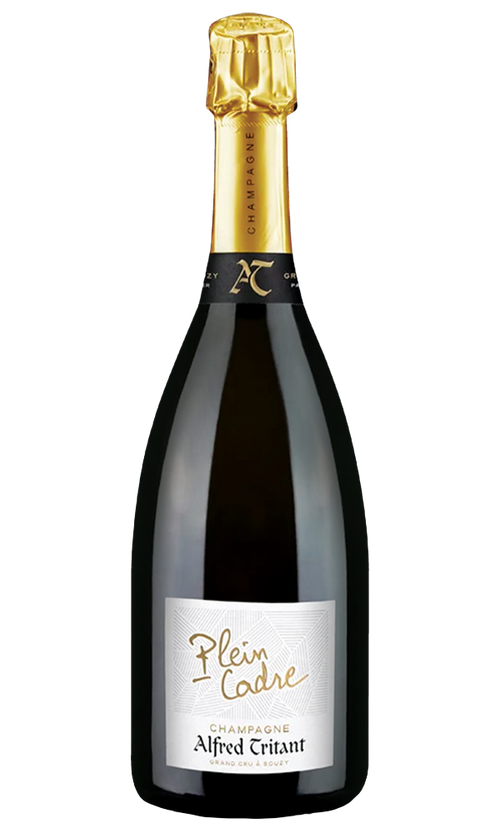
NV Champagne Alfred Tritant Plein Cadre Brut Champagne 750 ml
| $60 | per bottle | |
- Curated by unrivaled experts
- Choose your delivery date
- Temperature controlled shipping options
- Get credited back if a wine fails to impress
Pinot Noir, Full Frame
Bouzy and Ambonnay, on the south-facing slopes of the Montagne de Reims, are among the best places on earth to grow Pinot Noir for sparkling wine. Both are rated Grand Cru, and both are Pinot country to the core. Plein Cadre is a single-varietal Blanc de Noirs drawn entirely from these two villages—one grape, from two of its finest addresses.
The name points to the wine's focus: “Plein cadre” means “full frame”. This is Pinot Noir given the whole picture, with nothing else in the shot.
The Tritant family has farmed in Bouzy since 1930, and the estate is run today by Jean-Luc Weber-Tritant, grandson of founder Alfred. It has always been a grower-producer operation: the family grows the grapes and makes the wine, start to finish.
It's a tiny domaine—2.71 hectares, about 6.7 acres, spread across 18 plots, with vines averaging around 45 years of age. A typical year yields less than 2,000 cases across the entire range. The vineyards have been certified organic since 2023, and the family keeps a small flock of Ouessant sheep to graze the rows.
In a region where Pinot Noir is usually blended with Chardonnay for lift, a Blanc de Noirs leans into what the grape does best here: depth, breadth, and a generous red-fruited core.
Much of the wine's resonance comes from the blend behind it. A little under half is drawn from a single recent harvest, and the balance comes from the estate's perpetual reserve—an ever-evolving library of older wines, topped up and drawn from year after year. That reserve folds age and complexity into a nonvintage bottling.
The winemaking is unshowy and traditional. Fermentation happens in tank, the wine goes through malolactic fermentation to soften its acidity, and it finishes with a brut dosage of around 7 g/L—enough to buff the edges without tipping toward sweetness.
In the glass it's pale gold with a fine, persistent bead. Expect orchard fruit and citrus—green apple, pear, lemon zest—alongside white flowers, fresh brioche, and the faint red-fruit and pastry notes Pinot Noir brings with age. The palate is crisp but rounded, carried by a creamy mousse, with almond skin, chalk, and a saline echo on a clean finish.
You might also like these wines
- Member Favorite
- Member Favorite
- Member Favorite


- You're on page